

Welcome to
One Million Taxpayers for Peace

Imagine what will happen when the millions of Americans who oppose the government's escalating militarism proclaim in unison, "WE CHOOSE PEACE! WE'RE BOYCOTTING WAR!"

There are many ways to boycott war, including
refuse to serve in the military;
refuse to fund the military;
fund peacemaking, social justice, environmental, health, and education programs
be vocal in your community and to your legislators about your opposition to war and desire for peace and social justice;
refuse to purchase war toys or see movies or shows that glorify violence;
cut down on fossil fuel consumption;
use language of cooperation and connection rather than that of competition and separation:
practice kindness;
working for campaign funding to be only from public monies
and more…

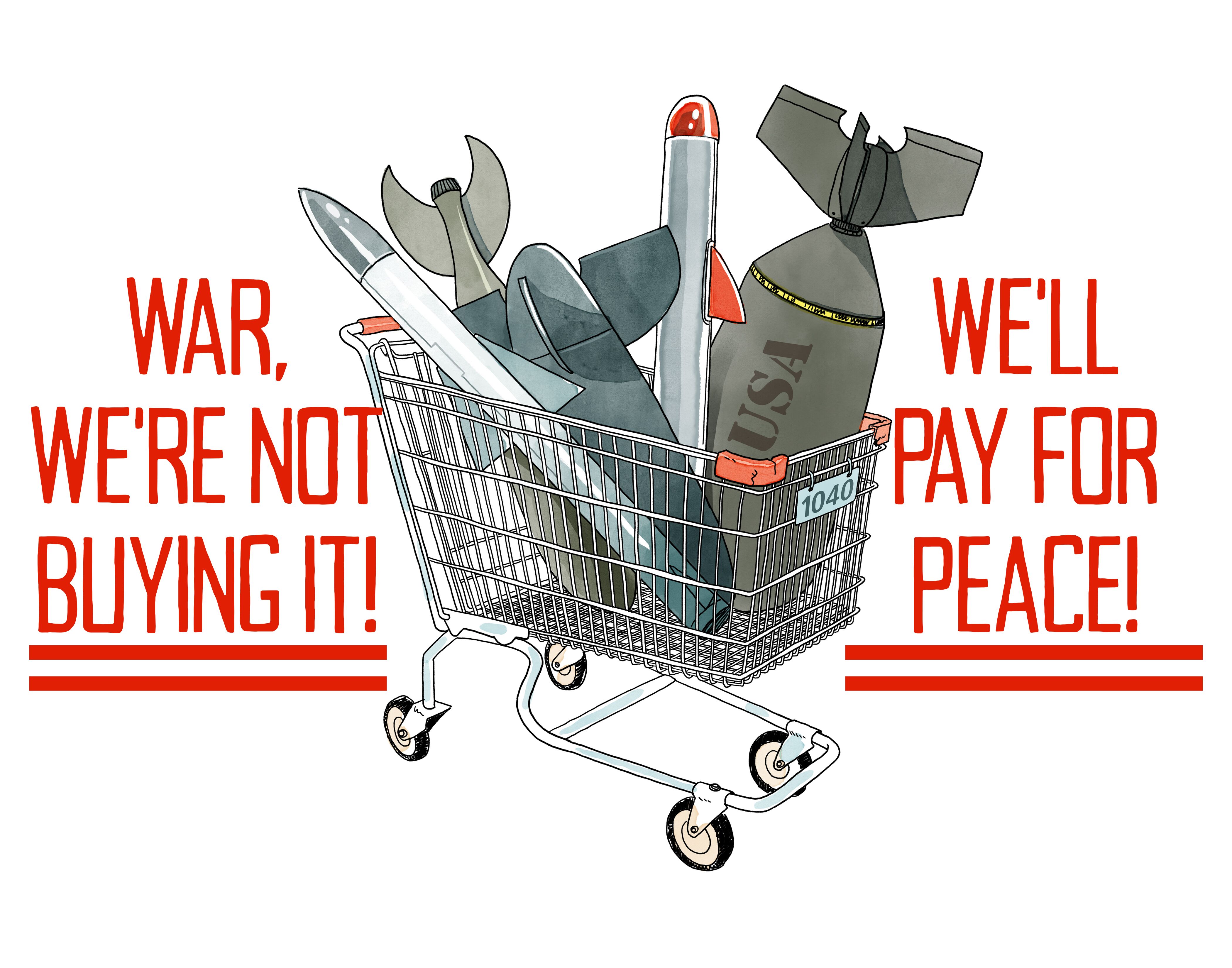
One Million Taxpayers for Peace provides resources about one strategy for boycotting war, "symbolic war tax resistance." What this means is, that one refuses to pay a very small portion--symbolically, $10.40--of federal taxes that fund the military and war. This site discusses why someone might want to do symbolic war tax resistance, how to do it, and answers frequently asked questions, called yes, but.

If you deliberately deduct $10.40 from your tax payment, you will be committing civil disobedience, and following in the footsteps of many courageous Americans whose acts of conscience led the country to positive reforms, such as abolition, women's vote, and civil rights laws. (The Role of Civil Disobedience in a Democracy)

Deducting a symbolic $10. 40 from one's taxes seems more possible for peace activists than the customary 50-100% war tax resistance. Boycotting this low amount of money makes a statement of conscience, while being so low an amount that penalties and interest are negligible. Likewise, risk is negligible; one is not at risk for harassment or arrest, nor does it put one's car, home, or other assets in risk of collection.

War tax resistance is a centuries-old form of civil disobedience regarding taxes. War tax resisters refuse to pay taxes for war, sending their tax money instead to groups working for peace and community social needs. For those not familiar with war tax resistance, the idea is often scary, conjuring up images of jail and homes confiscated. Although such events are extremely rare for war tax resisters, most peace activists continue to pay their war taxes in full, without protesting.
One Million Taxpayers for Peace has not heard of any legal actions taken against symbolic war tax resisters. We feel obliged to inform you, however, that there could be legal consequences if you engage in this form of civil disobedience. This site and others provide information on this ["some thoughts"in yes, but and http://www.warresisters.org/consequences.htm].

How to become a Taxpayer for Peace:

Why become a Taxpayer for Peace?

If you want peace, pay for peace.

If you want peace, stop paying for war.

"Let them march all they want, as long as they pay their taxes."
      attributed to Alexander Haig, June 1982, serving under Pres. Reagan,

The Pentagon receives about one-half of every dollar that Congress annually allocates
(Learn More). If you disagree with these priorities, becoming aTaxpayers for Peace is a small, significant step you can take to help keep your conscience intact and let your voice be heard.

While considering whether to commit civil disobedience, you might also consider the consequences and risks involved in paying your taxes in full:

The $10.40 you're not spending for war you can redirect to life-affirming programs.

"If a thousand men were not to pay their tax-bills this year, that would not be a violent and bloody measure, as it would be to pay them, and enable the State to commit violence and shed innocent blood. This is, in fact, the definition of a peaceable revolution, if any such is possible."
      Henry David Thoreau, Civil Disobedience


How do you feel...

When you think about how your federal taxes are spent?

When you think about refusing to pay for war?

When you think about redirecting your taxes towards peace?

What fears or concerns do you feel about redirecting war taxes?

What hopes do you feel about redirecting war taxes?

In making decisions, how important is each of the following:
Personal values
Financial concerns
Convenience, effort
Risk
Anticipated results

When you disagree with the government, where and when do you draw the line in going along with them?

Yes, but...

Specific concerns

Some thoughts

Cost-benefit analysis

Role of civil disobedience in a democracy

Sample Letter

Your name
Your address

Addressee name
e.g. Senator, Representative, President
or Aunt Mildred, Daily Bugle Editor, etc.
Address
Elected officials' addresses usually in front pages of phone book

Date

Dear ______________________,

I am devoted to the possibility of world peace, and am taking action towards that end. So, along with tens of thousands of other taxpayers, I am paying my federal taxes only under protest this year. My conscience demands that I resist, in some way, complicity in funding our excessive military spending and actions.

There is no military "answer" to terrorism. Our "war on terrorism" has now killed many times over the number of innocent civilians than were killed September 11, alienated most of our allies and most of the world populations, and created countless more angry, desperate people willing to resort to terrorist acts.

I ask you to look at history. I ask you to look into your heart. If attacking terrorist strongholds were a viable solution, wouldn't Israel and Palestine have long ago settled into peaceful coexistence?

What of honest inquiry into the roots of terrorism, and addressing what motivates such desperate acts?

As a gesture of opposition to my government's disproportionate military spending, I am refusing the federal government $10.40 of what they expect from me. I am sending the money, instead, to ________________[e.g. our local homeless shelter] so my money is supporting life, rather than destroying it.

I invite you to join me in this affirmation of individual responsibility for a world at peace. We cannot continue to pray and work for peace yet pay for war.

In peace,
Your signature here

Your typed name here

Other possible points to write about:

*How U.S. military budget equals all the other military budgets in the world, combined!

* How the bloated military budget takes money away from domestic needs such as education, healthcare, environmental protection and restoration, renewable energy research, crime and violence prevention, etc. Here's a good quote on that: "Every gun that is made, every warship launched, every rocket fired, signifies in the final sense a theft from those who hunger and are not fed, those who are cold and are not clothed." President Dwight D. Eisenhower, April 16, 1953

*Instead of exporting weapons and war, the United States needs to be providing leadership in a multinational political and legal course to address terrorism, aggression, and conflict. We need to be promoting civil, political, and economic human rights along with humanitarian and environmental aid to foreign countries, and here at home as well.

*Tie in the current issues relevant to your refusal and redirection of $10.40.

OMTFP History
One Million Taxpayers for Peace (OMTFP) was initiated in response to the government's military actions following September 11, 2001.

OMTFP is an outgrowth of a "1040 Club" [http://www.tea-circle.com/sctfp/1040club.html], which involves the low-risk refusal of paying $10.40 of income taxes which would go to war expenses. Knowing that close to 50% of their tax dollars fund military programs that conflict with their ethics, 1040 Club members feel morally obligated to resist, redirect, and speak up. The strategy of a 1040 Club is to achieve widespread participation, and thereby, be able to effect political change.

OMTFP was originally a campaign to inspire at least 1,000,000 people nationwide to symbolic war tax resistance and redirection of their $10.40 to nonviolent conflict resolution programs in schools nationwide. Endorsed by Helen Caldicott, NWTRCC, Every Church a Peace Church and others, we'd hoped to create a collective voice against war and violence that was loud enough to break through the political and media barriers against dissent, as well as provide funds to make nonviolent conflict resolution a reality in every community.

Unfortunately, the campaign did not generate enough energy to keep going. We did, however, inspire several local groups to spring up. Axis of Peace, and Austin Taxpayers for Peace are two that we know of; we've heard tell of others.

In March, 2003, we were able to make grants from redirected war taxes from peace tax payers living in 16 states, on both coasts, in the midwest, the south, and the Capitol.

$315 to Children's Creative Response to Conflict,,
$315 to Help Increase the Peace Program (HIPP),
  $70 (10%) to Peace Tax Fund Bill,]

And, in spring 2004, we granted the same organizations a total of $807 from 64 donors (some couples, so more than 64 individuals) in 20 states and again spanning the country's geographic range, including Washington, D.C.

As of June 2004, OMTFP is a Resource site for symbolic war tax resistance. The site is offering information only, leaving outreach and campaigns to local organizations.

We thank NWTRCC for hosting the current site.

And we are very grateful to Conscience and Military Tax Campaign and Sonoma County Taxes for Peace for their support from Day 1 of OMTFP.


Links